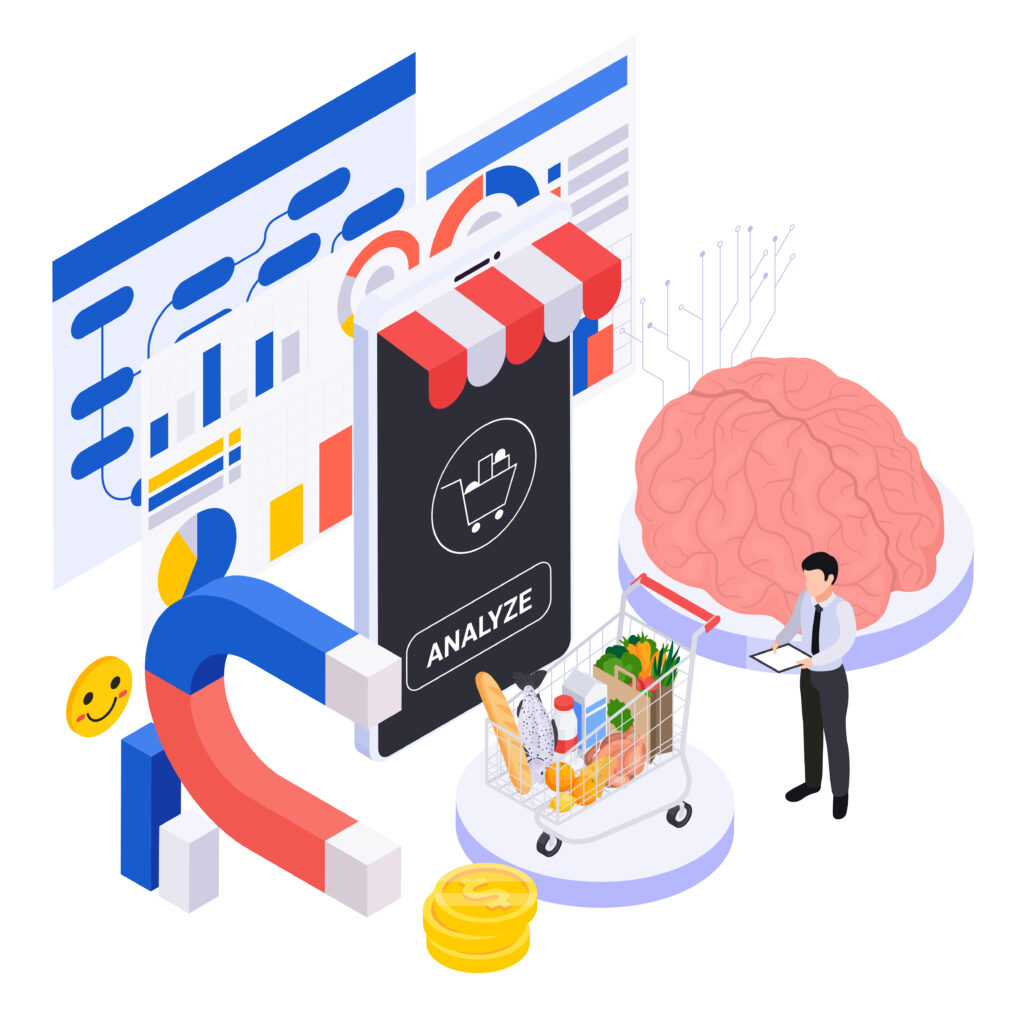




In the crowded digital marketplace, capturing a user’s fleeting attention and converting it into a sale feels like a constant battle against distraction. Traditional marketing relies on logic and self-reported desires, but the truth is, 95% of purchasing decisions are driven by the subconscious mind, according to Harvard professor Gerald Zaltman.
This is where Neuromarketing steps in.
Neuromarketing is the fascinating fusion of neuroscience, psychology, and marketing. It uses scientific insights into how the human brain processes information, makes decisions, and forms memories to optimize marketing materials—from website design and ad copy to pricing strategies and product packaging.
By speaking directly to the brain’s “fast, emotional, and lazy” System 1 (as described by Nobel laureate Daniel Kahneman), you can bypass rational resistance and dramatically boost your conversion rates.

The Power of Visual Primes: Focus on the Eyes and Faces
The human brain is hardwired to prioritize social and emotional signals. Faces and eyes are the fastest things we process.
A. The Directed Gaze Trick
When a model or figure on your landing page is looking directly at the product, headline, or call-to-action (CTA), the user’s eye instinctively follows the gaze. This simple, subtle cue acts as an unconscious guide, directing attention to the most important conversion element.
Trick: Use high-quality images of people looking towards the form, the “Buy Now” button, or the main value proposition. Avoid using images where models look directly at the user, as this can sometimes be perceived as a distraction rather than a guide.
B. Emotional Resonance through Faces
Faces trigger instant empathy and trust. A face displaying the desired post-purchase emotion (joy, relief, satisfaction) is far more effective than a generic stock photo.
Trick: If selling a productivity app, show a face of a user looking relieved and focused. If selling a fitness product, show a face of someone energized. This allows the potential customer to project themselves into that positive emotional outcome.
Cognitive Fluency: Make It Easy to Process
The brain is inherently lazy. It prefers information that is easy to process, interpret, and understand—a concept called Cognitive Fluency. The easier something is to read, the more trustworthy and true it feels.
A. Simplify Your Language and Font
Complex words and hard-to-read fonts force the brain to work harder, triggering friction and resistance. This unconscious effort translates into a perceived “difficulty” in using the product itself.
Trick: Use clear, simple language and fonts (like Sans-Serif options such as Arial or Roboto) that have high contrast. Keep headlines short (under 7 words) and use formatting (bolding, bullet points, white space) to make content instantly scannable. If they have to work to read it, they won’t buy it.
B. The Processing Bias of Rhyme
Studies have shown that phrases that rhyme or use alliteration are perceived as more truthful and memorable (e.g., “An apple a day keeps the doctor away”).
Trick: Incorporate simple rhyming or rhythm into your CTAs or slogans to boost memory and perceived credibility.
Harnessing Fear and Scarcity (Loss Aversion)
Nobel laureate Daniel Kahneman also popularized the concept of Loss Aversion: the pain of losing something is twice as psychologically powerful as the pleasure of gaining something equivalent. Neuromarketing exploits this by focusing on what the customer will miss out on or lose if they don’t convert.
A. The Fear of Missing Out (FOMO)
FOMO is a direct application of loss aversion. When users perceive a dwindling supply or a ticking clock, the fear of losing the opportunity overrides rational deliberation.
Trick: Use real-time inventory counters (“Only 3 left in stock!”), limited-time flash sales with prominent countdown timers, and messages about sales ending soon.
CLG Note: Combine this with Community-Led Growth (CLG) by highlighting how many other people are viewing or buying the item right now (“24 people are looking at this flight right now!”).
B. Framing the Loss
Instead of saying “Gain a 20% discount,” try framing it as: “Don’t lose out on a 20% saving.” While the financial outcome is the same, the psychological impact of avoiding a loss is much stronger.
Anchoring and Decoy Effect in Pricing
Pricing is perhaps the most direct application of neuromarketing. The brain doesn’t like calculating absolute value; it prefers relative comparison.
A. The Anchoring Bias
The first piece of information the brain receives acts as an anchor against which all subsequent information is judged.
Trick: When displaying a sale price, always show the original, higher price first and cross it out prominently. The brain anchors to the original high price, making the discounted price seem like a fantastic deal, even if it’s the standard market rate.
B. The Decoy Effect
This trick involves introducing a deliberately unattractive third option (the decoy) to make a preferred option look significantly better.
The Endowed Progress Effect: Small Wins, Big Motivation
The Endowed Progress Effect states that people are more motivated to complete a task if they feel they have already made progress towards it. This exploits the psychological need for completion and forward momentum.
Trick: Start a sign-up process by showing it is already partially completed (e.g., “Step 1 of 4: Enter your name – 25% Complete!”). Even though the user hasn’t done anything yet, the illusion of initial progress motivates them to finish the remaining steps.
Progress Bars: Use clear, visual progress bars during checkout, form submissions, or onboarding to reduce dropout rates. Seeing the finish line encourages users to push through the remaining effort.
The Ethical Imperative of Neuromarketing
While these tricks are powerful, they come with an ethical responsibility. Neuromarketing should be used to clarify the value proposition and reduce friction in the buying process, not to deceive or manipulate.By appealing to the brain’s natural tendencies—its focus on faces, its preference for ease, its fear of missing out, and its reliance on comparison—you can create a more intuitive, compelling, and ultimately, high-converting customer experience. Stop selling to the conscious mind; start communicating with the subconscious.